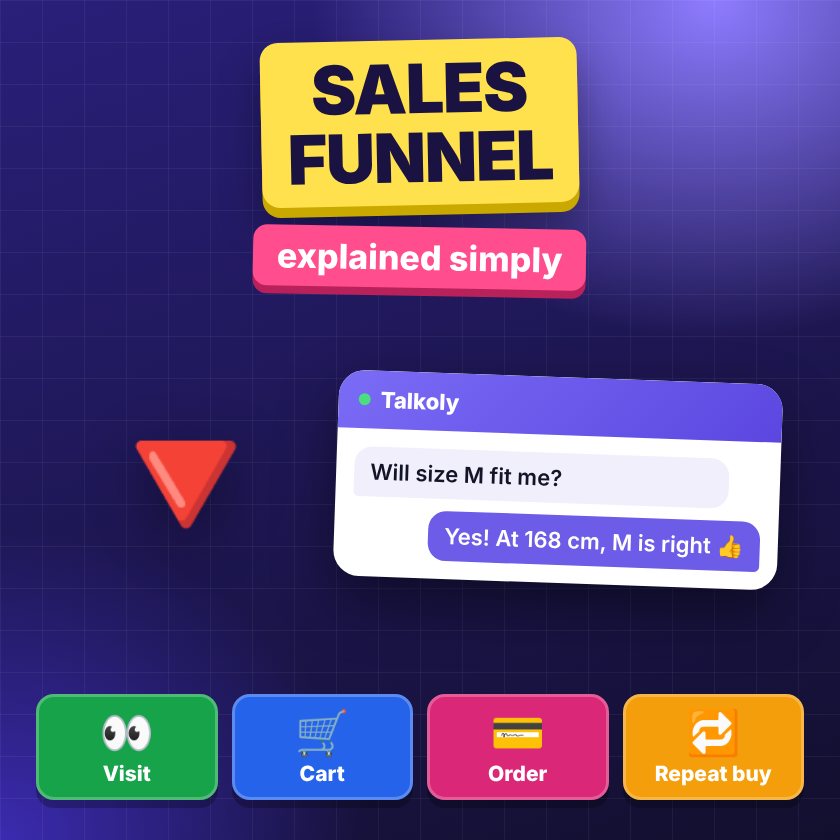
- A sales funnel is the buyer’s path from “first saw the store” to “bought and came back again”.
- At every step some people leave. Your job is to find the step where the most people leave and fix that one.
- For a small store, 5 stages and a simple spreadsheet are enough — no complex software needed.
- The cheapest place to improve is the moment a person has doubts. Quick replies in chat work well here.
A sales funnel is a way to look at your store through a buyer’s eyes. A person comes to the site, looks at products, puts something in the cart, places an order, gets the parcel and, if they liked everything, comes back. At the top of the “funnel” there are many people; at the bottom, fewer. Hence the name: wide at the top, narrow at the bottom.
The benefit is simple. When you see each step separately, it becomes clear where to put your effort. You could spend a month redoing your ads, when the real problem is that buyers don’t understand the delivery terms and close the checkout page.
Stages of an online store sales funnel
Different textbooks name the stages differently, but the idea is the same. For a small store, this set works well:
- Visit. A person landed on the site: from an ad, Google search, Instagram or a friend’s tip.
- Interest. She opened a product page, flipped through the photos, read the description.
- Cart. She added the product to the cart.
- Order. She placed and paid for the order (or chose cash on delivery).
- Repeat purchase. She got the parcel, was happy and came back.
An example from a ceramics store: 1,000 people visited the site, 400 opened at least one cup, 60 put something in the cart, 25 placed an order, and 8 bought again within a few months. The numbers are made up, but this picture is typical: most people are lost between “looked” and “added to cart”, and between “cart” and “order”.
How to count your funnel in one evening
You don’t need an expensive system. Open a normal spreadsheet and write down the numbers for the last month.
- Visitors — from Google Analytics or your platform’s statistics (Horoshop, a popular Ukrainian store builder, as well as Prom.ua, a large Ukrainian marketplace, and WooCommerce show this in the admin panel).
- Product views — in the same place, in the page reports.
- Add-to-carts — in the e-commerce reports or the abandoned cart report.
- Orders — from your store’s admin panel.
- Repeat buyers — count the phone numbers or emails that appear in orders more than once.
Then divide each number by the one before it. You’ll get the conversion rate of each step — that is, the share of people who moved on. For example, 60 carts out of 400 views is 15%. Compare not with the “market average”, but with yourself last month.
Where stores most often lose buyers
Between visit and interest
A person came in and left right away. Reasons: the site loads slowly, the ad promised one thing and the page shows another, everything breaks on a phone. Check your site from your smartphone on mobile data — the way most buyers see it.
Between interest and cart
The product is interesting, but there’s a doubt. Will the size fit? Is it dishwasher safe? When will it ship? If the answer can’t be found in a few seconds, the person puts off the purchase “for later”. And often “later” never comes.
Between cart and order
Here, surprises scare people off: delivery costs more than expected, registration is required, the form is long, there’s no convenient way to pay. This is covered in detail in the article about abandoned carts.
After the first purchase
The parcel arrived — and the store vanished from the customer’s life. No thank-you, no review request, no reminder when the cat food runs out. Yet a repeat buyer usually costs much less than a new one from ads.
What to do at each stage: a checklist
| Stage | What to check | What you can do quickly |
|---|---|---|
| Visit | Where people come from and whether they’re “your” people | Mark the links in your ads with UTM tags to see the sources |
| Interest | Photos, description, price, stock | Add sizes, materials and “ships tomorrow” right on the product page |
| Cart | Whether it’s easy to ask a question | A website chat that replies within a minute or two |
| Order | How many fields the form has, what payment methods there are | Remove extra fields, add card payment |
| Repeat | Whether you have the customer’s contact and a reason to write | Say thank you, ask for a review, remind them about a product that’s running out |
Chat as a “bridge” between doubt and purchase
The narrowest point in most funnels is the moment of doubt. The person is almost ready to buy, but one question stops them. If there’s a chat button right there and someone replies quickly, the purchase often happens. If the answer comes tomorrow, the person has already bought elsewhere.
A few examples of how chat clears up doubts:
— Does this jacket run large?
— A little, yes. At 175 cm tall, most people who usually wear M take S. If it doesn’t fit, we’ll exchange it for free.
— Will this harness fit a dachshund?
— Yes, the chest strap adjusts from 35 to 50 cm. Tell me your dog’s chest size and I’ll pick the right one.
— Do you have brake pads for a 2015 Skoda Octavia?
— We have two models in stock. Send me the VIN code (the vehicle number from the registration papers) and I’ll check compatibility in a minute.
Talkoly has a few useful things for this stage: you can see who is on the site right now and which page they’re viewing, so you can write first. And during the conversation, the agent can send a monobank (a popular Ukrainian mobile bank) or LiqPay invoice right away — the customer pays without leaving the chat. Learn more on the live chat for website page.
How not to lose people when you’re away
Evenings, weekends, air raid alerts, power outages — buyers’ questions keep coming then too. To keep the funnel from “leaking” during those hours:
- Collect contacts. The offline form asks for a phone number, Telegram or email. In the morning, you write first.
- Write an honest auto-message. “We’re offline right now and will reply tomorrow by 10:00. Leave your number and we’ll call you.”
- Reply from your phone. Even a short “Yes, it’s in stock, I’ll send details tonight” keeps the person interested.
- Don’t promise what you can’t deliver. “We’ll reply by lunchtime” is better than “in 5 minutes” followed by silence.
We looked at why speed affects sales so much in a separate article — about reply speed.
The bottom of the funnel: repeat purchases
Many owners stop at the “order” stage. But the most profitable part starts after the first purchase: the person already trusts you.
- Say thank you after delivery. “Thank you for choosing us! How do you like the cup? If anything’s wrong, write here.”
- Ask for a review a few days after delivery, once the product has been tried out.
- Remind people about consumables. Pet food, filters and cosmetics run out predictably — you can write a week before that.
- Tell people about new products if they bought similar items, not everyone at once.
To keep these reminders from getting lost, it helps to keep a simple customer list with purchase history. More on that in the article CRM for an online store.
Common funnel mistakes
- Pouring more ads into a “leaky” funnel. If few people get past the cart, new visitors will get lost there too.
- Measuring only sales. Without the steps in between, you can’t tell what exactly broke.
- Changing everything at once. You changed the design, prices and delivery in one week — and now you don’t know what worked. Change one thing at a time.
- Not asking buyers. Sometimes the best analytics is to ask in the chat: “Could you tell me what stopped you?”
FAQ
What is a sales funnel in simple words?
It’s the buyer’s path, step by step: visited the site, looked at a product, put it in the cart, bought, came back. At every step some people leave, and the funnel shows exactly where.
How many stages should an online store funnel have?
Five are enough for a small store: visit, interest, cart, order, repeat purchase. Add more stages only once you’re measuring these five regularly.
How often should I review my sales funnel?
Once a month is plenty. After noticeable changes — new ads, a promotion, a new payment method — look again in a week or two to see the effect.
Does live chat help the sales funnel?
Yes, especially at the “interest” and “cart” steps, where the buyer has doubts. A quick answer to one question often decides whether there will be an order.