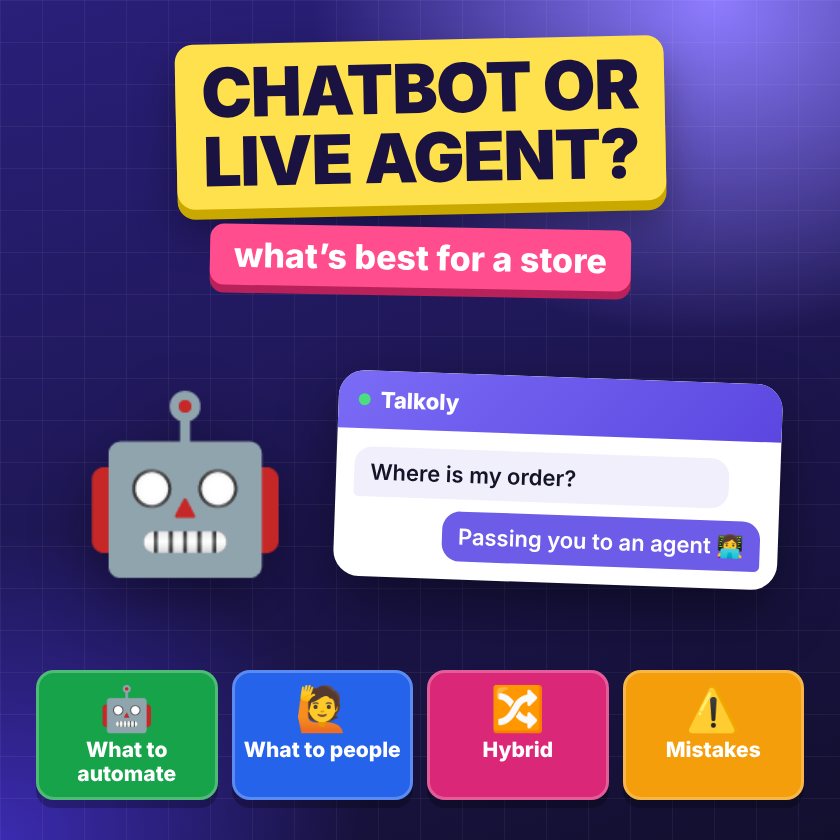
- “Bot or human” is the wrong question. For most stores, a hybrid works best.
- Give the bot common questions, after-hours time and collecting contacts. Leave to people complaints, difficult choices and anything involving money and orders.
- 80% of an AI assistant’s quality depends on the knowledge base. Write it as short articles: “one question — one answer”.
- The biggest mistake is a bot with no way to reach a human.
The honest pros and cons
Let’s skip the marketing. Both a bot and an operator (the person who answers in chat) have strengths and weaknesses, and neither covers all of a store’s needs alone.
| Chatbot / AI assistant | Live operator | |
|---|---|---|
| Availability | 24/7, no days off | During working hours, depends on the schedule |
| Speed | Instant | From seconds to minutes |
| Common questions | Answers equally well every time | Answers well, but it’s a routine that wears people out |
| Unusual situations | Weak: gets lost or answers the wrong question | Strong: understands context, emotions, hints |
| Selling and upselling | Can suggest, but doesn’t feel when to push | Hears doubt and knows how to handle it |
| Trust | Lower, especially when the person is upset | Higher: it’s easier to come to an agreement with a person |
| Cost of scaling | Barely grows with the number of conversations | You need to hire new people |
The conclusion is simple: a bot wins where you need speed and round-the-clock answers to common questions. A person wins where you need understanding, flexibility and decisions.
What to hand over to the bot
Common questions
Delivery, payment, returns, warranty, opening hours, showroom address, how to track a parcel. These questions repeat every day, and the answers don’t change for weeks. An operator who types “we ship with Nova Poshta (Ukraine’s largest delivery service)” for the tenth time that day adds nothing to the conversation.
After-hours time
Evenings and nights are when people calmly browse catalogs. If at 11 pm a customer asks whether they can pay in installments and gets an answer right away, they will most likely place the order instead of putting it off “for later”. The bot doesn’t replace the operator here — it covers the hours when there is no operator anyway.
Collecting contacts
When the bot doesn’t know the answer or the question needs a person, the most useful thing it can do is politely ask for a phone number, Telegram or email and promise that someone will get in touch. In the morning, the operator gets a ready list of warm requests.
What should stay with people
Complaints and conflicts
The parcel arrived damaged, the wrong item came, the money wasn’t refunded. The person is upset, and the last thing they want is to talk to a robot. Here the bot has one job — quickly pass the conversation to an operator. Any attempt to “solve” a complaint with a template only makes things worse.
Difficult choices
“Which vacuum cleaner should I get if I have a cat, carpets and a child with allergies?” A good consultant will ask two clarifying questions, recommend a specific model and explain why. These are the conversations that most often end in a big purchase — and the ones that are risky to leave to automation.
Orders, payment, delivery
Placing an order, sending an invoice, changing an address, creating a waybill (TTN) — these are actions with consequences. A mistake here costs money and nerves. Let a person do it, ideally without leaving the conversation: in Talkoly on the Business plan, an operator can send a monobank or LiqPay invoice right in the chat and see the “✅ Paid” mark, and add a waybill number whose status the customer sees in the conversation.
How to build a hybrid setup
A setup that works for most online stores looks like this:
- Working hours — people. Operators reply themselves, using quick replies for common questions. The bot stays out of it.
- After hours — the AI assistant. It answers common questions from the knowledge base. If there is no answer, it says so directly, asks for a contact and passes the request to people.
- Morning — review. The operator looks through night conversations, writes first to those who left a contact and notes the questions the bot couldn’t handle. These questions become new knowledge base articles.
The last point is the most important. A hybrid is not a “set it and forget it” setting but a cycle: people fill the bot’s gaps, and the bot frees up people’s time.
In Talkoly, the AI assistant is available on the Pro plan and works exactly like this: it answers from the knowledge base when operators are away, and if it doesn’t know the answer, it passes the conversation to people and asks for a contact. Learn more on the website chatbot page.
How to write a knowledge base for an AI assistant
An AI assistant answers only as well as the knowledge base is written. If it has confusion, outdated prices and vague phrases, the bot will repeat them to customers word for word.
Structure
- One article — one question. Not “Everything about delivery” over two screens, but separate articles: “How much does delivery cost”, “When do you ship orders”, “Can I get delivery to a parcel locker”.
- The title is the customer’s question. The way people write it in chat, not the way it sounds in your terms of sale.
- The answer is in the first sentence. Details and exceptions go below.
- Sections by topic: delivery, payment, returns and exchanges, warranty, products and choosing, about the store.
An example of a good article
Can I return an item if it doesn’t fit?
Yes, within 14 days of receiving it, if the item hasn’t been used and the packaging is intact. Send us your order number in chat — we’ll send you instructions. The buyer pays for return shipping, unless the item is defective.
Why it works: the “yes” comes right away, the conditions are specific, there is a next step and an exception. The bot can quote it almost word for word, and the customer gets a full answer.
An example of a bad article
Returns
Product returns are carried out in accordance with the applicable legislation of Ukraine and the terms of the public offer published on the website.
Technically correct, practically useless. The customer still doesn’t know if they can return the item.
What else to add
- An article “What to do if your question isn’t on this list” — asking the customer to leave a contact.
- Answers to questions people ask before buying: installments, cash on delivery, shipping times on weekends.
- The date the article was last checked. Outdated prices and timelines are the most common source of bot mistakes.
Mistakes that ruin the bot’s value
A loop with no way out
The customer writes “I want to talk to a human”, and the bot shows the “Delivery / Payment / Returns” button menu for the third time. This is the fastest way to make a buyer angry. There must always be a way to reach a person: on request, after a few failed attempts and in every emotional situation.
The bot pretends to be human
The name “Olena”, a photo of a smiling young woman and answers that are clearly generated. When the customer notices, trust in the whole store drops. Be honest and call the assistant an assistant.
The bot makes things up
If the knowledge base has no answer, the bot should not invent one. “I don’t have exact information; leave your contact and a manager will check” is better than a confident lie about delivery times or discounts.
The bot works during the day instead of people
Some stores stop replying themselves once they get a bot. The result is fewer complex sales and more misunderstandings. The bot should take load off the team, not replace it during the hours when customers are ready to buy.
A knowledge base nobody updates
Delivery prices changed, a new payment method appeared — and the bot still talks about the old terms. Name one person in charge and review the base at least once a month.
What to choose for your store
- A small store, one or two operators, few night requests — a live chat, quick replies, working hours and an offline form are enough. You don’t need a bot yet.
- Many common questions in the evenings and on weekends — add an AI assistant for after-hours time and start with 15–20 knowledge base articles.
- A big team, many channels — a hybrid with departments, conversation transfers and a regular review of questions the bot couldn’t answer.
How not to lose customers while they wait during working hours — read why response time decides the sale. Ready-made lines for operators are in our live chat sales scripts.
FAQ
Can an AI assistant fully replace an operator?
For an online store — no. It handles common questions and after-hours time well, but complaints, difficult choices and placing orders are better left to people.
How many knowledge base articles do I need to start?
Start with the 15–20 most common questions: delivery, payment, returns, warranty, stock. Then add articles for the questions the assistant couldn’t answer.
What does an AI assistant do if it doesn’t know the answer?
A properly set up assistant doesn’t make things up. It says directly that it doesn’t have exact information, asks for a contact and passes the request to people. That’s exactly how the Talkoly AI assistant works.
Should I hide that a bot is answering?
No. Customers usually notice it themselves, and trying to pass a bot off as a human hurts trust. Be honest and call it an assistant, and give people a way to call a human.